Something Fishy

February 12th, 2009

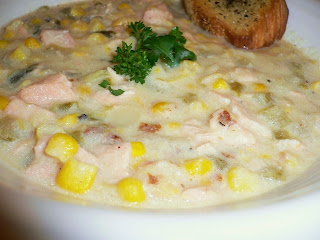
My husband, David, likes fishing and motorcycles, and also occasionally likes to try his hand in the kitchen. Recently, when one of his riding buddies called to confirm their plans for Daytona Bike Week, Ron happened to mention that he had just enjoyed a delicious seafood corn chowder in a restaurant. The corn chowder had incorporated both salmon and smoked trout, and Ron loved it. That started the wheels turning in David’s head due to the happy coincidence that he had several smoked blue fish chilling in the fridge without a good plan for their ultimate use. When he broached his plan with me, I was less than enthusiastic because not only am I not a fan of smoked fish in general, I have an aversion to blue fish in particular. He agreed that if I let him experiment with a seafood corn chowder, he would prepare two versions….one with salmon only for me, and the other with both salmon and smoked blue fish for his exclusive consumption. So, today I am turning the blog over to David. I loved his Seafood Chowder.

A quick Google search for corn chowder yielded a very basic and simple recipe that served as a good starting point. It called for one can each of both creamed corn and whole kernel corn, diced potatoes, celery, and condensed milk. Instead of the condensed milk, I substituted Skim Plus milk and some half-and-half, and added onion, green pepper, jalepeno pepper, garlic, and a little butter and sherry to the mix. The results were quite tasty, although I admit to overdoing it a bit on the smoked fish in my batch. Penny’s batch, with salmon only, was pretty good, and I think if I had it to do over again (and I will), I wouldn’t put a whole smoked fish into the rather small pot that I made for myself. A little smoked blue fish goes a long way in a chowder. It can take the place of the bacon, or pancetta, or salt pork that some recipes call for, but it would probably require only two or three tablespoons to impart a nice smokey flavor to a whole pot of chowder – a whole smoked fish in the pot was a little overpowering.

I should also mention the toasted sourdough french baguette with olive oil and pepper that I made to go with the chowder. I make this toast several times a week these days and we have both become seriously addicted to it. The baguettes are readily available at the ubiquitous Publix grocery stores here in Florida, but when we head back to Lake Lure in the spring we will either have to do without (I foresee severe withdrawal symptoms) or learn to make them ourselves. The simple recipe for the toast is included below.

SEAFOOD AND CORN CHOWDER

2 medium potatos, peeled and diced
2 stalks celery, diced
1 medium onion, diced

1 small green pepper, diced

2 jalepeno peppers, diced
4 cloves garlic, finely chopped
1 can creamed corn
1 small package of frozen corn niblets
1 fresh salmon fillet (about 3/4 lb) skinned and cut into 3/4 inch cubes
Diced Smoked fish to taste (don’t overdue it, a little goes a long way, but it adds a nice smoky flavor, and takes the place of smoked bacon or fatback called for in many chowder recipes)
1/2 cup Skim Plus milk (or milk of your choice)
A little half-and-half, maybe 1/4 cup — add more or less milk and/or half-and-half to achieve the consistency you desire in the chowder. I wanted it kind of thick.
1 Tbs olive oil for sweating the vegetables
1 Tbs sherry (just for the nice flavor it imparts — leave it out or use more as you desire)
1/2 tsp red pepper flakes for a little more kick
2 Tbs butter
salt and black pepper to taste

Directions:

Saute the potatoes, celery, onion, green pepper, jalepeno pepper, and garlic in a little olive oil in a large pot over medium heat to soften them and give them flavor. Add enough water to just cover the vegetables and simmer for 10 minutes or until potatos are cooked. Drain the water and add the creamed corn and corn niblets to the pot, followed by the milk, half-and-half, sherry, butter, and red pepper flakes. Add the cubed salmon and smoked fish and then salt and black pepper to taste. Simmer for about 20 minutes to be sure the salmon is cooked. Serve and enjoy with any bread of your choice, but if you have access to sourdough french baguettes, try the toast below.

Sourdough French Baguette Preparation:

Slice a sourdough french baguette on a diagonal making slices about 1/2 inch thick
Arrange slices on a baking sheet
Liberally coat each slice with olive oil and rub the oil in
Top each slice with fresh ground black pepper to taste
Place in a toaster oven or under the broiler of an oven until nicely browned
Printable recipe – Seafood and corn chowder

Barefoot Blogger’s Real Meatballs and Spaghetti

February 12th, 2009

The Barefoot Bloggers are a group of foodies who post twice a month on recipes from The Barefoot Contessa, Ina Garten. Each member has a turn picking a dish from one of Ina’s many cookbooks or recipes featured on the Food Network. The first choice for February, Real Meatballs and Spaghetti, was chosen by Rebecca of Ezra Pound Cake. Visit her blog for a funny and informed look at cookery. The reason I became a Barefoot Blogger is because I find Ina Garten’s recipes to be straightforward ( no cream of mushroom soup here), seasonal, and usually delicious. Many of her recipes have become a permanent part of my repertoire. For the most part I liked this recipe. The meatballs were wonderful. I did cut way back on the salt though. To my taste, Ina overdoes the salt. I ended up with 22 meatballs as opposed to her 16. The three meats made for a flavorful combination and the addition of parmesan cheese added an extra tang. My problem was with the sauce. There was not enough of it and the flavor was just so so. If I were to do this again, I would double the sauce and add more aromatic herbs like basil, oregano and thyme. As it was, we had delicious meatballs left over for sandwiches on toasted sourdough bread. Thank you Rebecca! See all of you in two weeks for Meringues Chantilly.

REAL MEATBALLS AND SPAGHETTI

For the meatballs:
1/2 pound ground veal
1/2 pound ground pork
1 pound ground beef
1 cup fresh white bread crumbs (4 slices, crusts removed)
1/4 cup seasoned dry bread crumbs
2 tablespoons chopped fresh flat-leaf parsley
1/2 cup freshly grated Parmesan cheese
2 teaspoons kosher salt ( I used 1/2 teaspoon)
1/2 teaspoon freshly ground black pepper
1/4 teaspoon ground nutmeg
1 extra large egg, beaten
Vegetable oil
Olive oil

For the sauce:
1 tablespoon good olive oil
1 cup chopped yellow onion ( 1 onion)
1 1/2 teaspoon minced garlic
1/2 cup good red wine, such as Chianti
1 (28-ounce) can crushed tomatoes, or plum tomatoes in puree, chopped
1 tablespoon chopped fresh flat-leaf parsley
1 1/2 teaspoons kosher salt ( I used less)
1/2 teaspoon freshly ground black pepper

For serving:
1 1/2 pounds spaghetti, cooked according to package directions
Freshly grated Parmesan

Directions:
Place the ground meats, both bread crumbs, parsley, Parmesan, salt, pepper, nutmeg, egg, and 3/4 cup warm water in a bowl. Combine very lightly with a fork. Using your hands, lightly form the mixture into 2 inch meatballs. You will have 14 to 16 meatballs.

Pour equal amounts of vegetable oil and olive oil intoa large (12 inch) skillet to a depth of 1/4 inch. ( I used less oil) Heat the oil. Very carefully, in batches place the meatballs in the oil and brown them well on all sides over medium-low heat, turning carefully with a spatula or a fork. This should take about 10 minutes for each batch. Don’t crowd the meatballs. Remove the meatball to a plate covered with paper towels. Discard the oil but don’t clean the pan.

For the sauce, heat the olive oil in the same pan. Add the onion and saute over medium heat until translucent, 5 to 10 minutes. Add the garlic and cook for 1 more minute. Add the wine and cook on high heat, scraping up all the brown bits in the pan, until almost all the liquid evaporates, about 3 minutes. Stir in the tomatoes, parsley salt, and pepper.

Return the meatballs to the sauce, cover, and simmer on the lowest heat for 25 to 30 minutes, until the meatballs are cooked through. Serve hot on cooked spaghetti and pass the grated Parmesan.

Printable recipe

Savory Leek and Ham Tart

February 8th, 2009

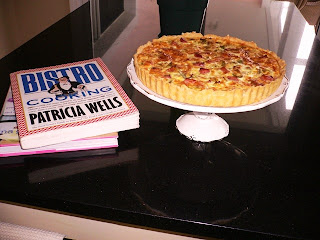
Pie crust has always been easy for me. I know many cooks claim to be intimidated by the prospect of making homemade pastry, but for some reason, I enjoy the mixing, rolling, trimming and crimping. It probably has alot to do with my Mother and Grandmother. I grew up in a small town in Michigan in the house where my Mother was born. My Grandmother lived with us and the two of them were always in the kitchen fixing comforting meals. When my brother and I were small, Grandma did a lot of the cooking, but over the years Mom took over most of it, with Grandma in the background offering encouraging comments like ” You aren’t going to have any potatoes left with the way you are peeling them”, or ” That pot roast is going to be dry if you don’t add more water.” But one thing they always agreed on was how to make pie crust. I have even inherited the measuring device they used for their Crisco. They never used butter in their pie crusts and I am sure that in her younger days my Grandmother probably used lard. So here is their recipe for pie crust if you would like to give it a try. For a 1 crust pie, use 1 cup of flour (with 1/4 tsp. salt), 1/2 cup Crisco cut into flour with a sharp knife until the shortening is the size of small peas, and then 1/4 cup milk stirred in. The ratio of 1, 1/2, 1/4 is easy to remember. A two crust pie would be 2,1,1/2. The dough is then rolled out on a heavily floured board. It is a very forgiving dough and can be rerolled without toughening it if you don’t get it right the first time. I have used this recipe for years, but have also discovered the flaky texture of pate brisee, the all butter alternative. And I have used some recipes that call for a mixture of both shortening and butter. But what I am sharing with you today is a pastry dough that I had never heard of before. It is made with olive oil.

In her book Bistro Cooking, Patricia Wells talks of a version of tart that is made in Provence with the local olive oil. The dish she describes is made with Swiss Chard, but having made it before, I found it to be too heavy and unappealing. I did like the crust though, so I came up with my own filling and tweaked the ingredients slightly for the crust. The advantage of this crust is that, when mixed together, it has the consistency of a cookie dough and all you have to do is is pat it into the tart pan. It does not have the buttery flakiness of most pie crusts, but it is crisp and thin and best of all, simple.

SAVORY LEEK AND HAM TART
Pastry:
1 1/4 cups unbleached all-purpose flour
1/4 tsp salt
1/4 cup plus 2 Tbls water
1/4 cup good extra virgin olive oil
Filling:
4 leeks, green stems removed, washed well and chopped
2 Tbls. olive oil
1/2 cup diced ham

1/2 cup grated Swiss cheese
3 eggs, beaten

1 cup half and half or heavy cream
Dash of nutmeg

Preheat the oven to 400 degrees. For the pastry, combine the flour and 1/4 teaspoon salt in a medium size bowl. Stir in the water and then the oil, mixing until thoroughly blended. Knead briefly. The dough will be very moist, much like a cookie dough. Press the dough into a 10″ loose-bottomed metal tart tin.

Saute the leeks in the heated oil over medium low heat until limp. Add the ham and brown slightly. In a bowl combine the beaten eggs, cream and nutmeg. Place the leek mixture into the prepared tart tin. Top with grated cheese. Pour the egg mixture over all and place in oven and bake for 40 minutes.

Printable recipe

Pork Roast with Prunes

February 6th, 2009

Since my last post I have been thinking about some of the cookbooks I have in storage and remembered one in particular. I believe the title is Simca’s Cuisine, written by Julia Child’s collaborator on Mastering the Art of French Cooking, Simone Beck. From what I recall of the history of their relationship, Simone could be fiesty and opinionated, but I found her cookbook engaging and warm. I am remembering a recipe for Pork Roast with Prunes – at least I think she had such a recipe, but since I do not have it here in front of me, I will make that assumption and tell you that I improvised this dish. Sometimes it is rewarding to rely on instinct while cooking. Pork and Prunes complement each other. Some recipes have you soak the prunes in Armagnac, which I’m sure is delicious, but the liquor cabinet at my house had no brandy of any description, so white wine was the best I could do. The initial preparation for this dish was a little time consuming, but was a welcome chore on a cold and blustery day. Once the roast was in the oven, I relaxed with my computer and enjoyed the heady aroma of dinner to come.

PORK ROAST WITH PRUNES

1 3 to 4 lb. center cut boneless pork loin
10 oz bag of pitted dried plums (I guess this sounds better than prunes)
1 cup white wine

2 to 3 shallots
3 T. olive oil
1/2 cup Panko crumbs (or dried bread crumbs)
2 sprigs Rosemary, stripped and chopped
1/2 cup chicken broth
Salt and Pepper to taste

Preheat oven to 350 degrees. Soak prunes in white wine. Butterfly pork loin by slicing through the middle lengthwise to within a few inches of the other side and open up and flatten it out. Place 1 tablespoon of oil in medium skillet and saute chopped shallots until softened. Add 1 more tablespoon oil to skillet and add bread crumbs and saute a minute more to brown slightly. Spread mixture on 1/2 half of opened pork loin. Top with salt, pepper and rosemary. Top with as many prunes as will fit and still allow you to fold roast back together easily. Once folded tie roast with twine at 1/2 inch intervals. Heat 1 tablespoon oil in large oven proof casserole and saute roast on all sides until nicely brown. Season with salt and pepper and any left over rosemary and add the remainder of the prunes and the soaking liquid to the casserole. Add chicken broth or water if you need more liquid. Bring liquid to a boil. Cover casserole and braise in oven for about 1 hour. Remove roast from casserole and let rest for 10 minutes. Remove twine, slice, and serve with pan juices.


Printable recipe

Salame di Cioccolata

February 4th, 2009


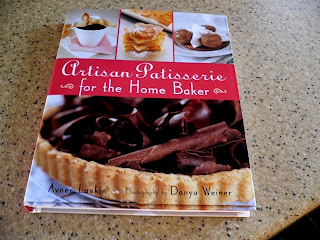
I love cookbooks and like many of my fellow food bloggers, I have an extensive collection. The bookcases in my kitchen are not finished yet, so for now, most of my precious books are still in storage and I miss them. That is the excuse I use to buy more and when I find obscure titles, at least ones that I have never heard of before, and find them at really, really reasonable prices, there is no question about buying them. I was in T.J. Maxx the other day and found this book for $3.99.

I am not a good baker. I even messed up chocolate chip cookies the other day, although it was the first time that it had ever happened. What causes the cookies to melt and flatten into each other and come out looking like flat crunchy discs? I blamed it on the oven here in Florida because I can’t imagine that my new Lake Lure convection oven could ruin anything. If someone has an idea of what I did wrong please let me know. But back to the cookbook – It covers Tarts, Eclairs, Cakes, Petits Fours, Cookies, Quiches, Cakes, Genoise, and more. I am going to attempt to post on many things from this book. The Salame di Cioccolata looked decadent and appropriate for Valetine’s Day. It was very simple to put together, somewhat like making fudge and the only complicated ingredient was the candied citrus rinds. Giada had a recipe for that, so once that was made, the rest took little time. This has got to be the best fudge I have ever eaten. Chocolate and orange have an affinity that is not to be believed, the cranberries add a soft texture and the almonds add crunch. Enjoy!

SALAME DI CIOCCOLATA

1/2 cup raisins ( I used dried cranberries)
9 ounces bittersweet chocolate, cut in small pieces
3 T. butter

1/3 cup sugar

1/3 cup whole almonds
1 cup butter cookie crumbs ( I used Keebler’s Sandies Shortbread)

2 egg yolks
Soak the raisins (cranberries) in hot water for 10 minutes and drain. Melt the chocolate and butter in the top of a double boiler. Add the sugar, almonds, cookie crumbs, orange peels, and drained raisins and mix well. Remove from heat. Whisk in the egg yolks. Let cool. Shape the mixture into a roll that is 12 inches by 1 inch. Cover completely with wax paper and let chill in the refrigerator for about 2 hours or until firm. When ready to serve, remove the wax paper and slice into 1/4 inch slices. Arrange on a serving plate and serve.

© Penny Klett, Lake Lure Cottage Kitchen. All rights reserved.